What happens if you don’t pay a private parking ticket
Nothing happens automatically, because it is not a fine — but the charge does not go away either, and the letters escalate on a pattern. The debt collection letter is the stage this page starts at. The letterhead changed, the amount grew, and the language turned to "further action". That jump — operator to debt collector — is designed to feel like escalation into enforcement. Legally, almost nothing has happened: the same unproven invoice has been handed to a louder messenger. Here is exactly what the firm holding your file can and cannot do.
Sources read at source · 01/09/2026
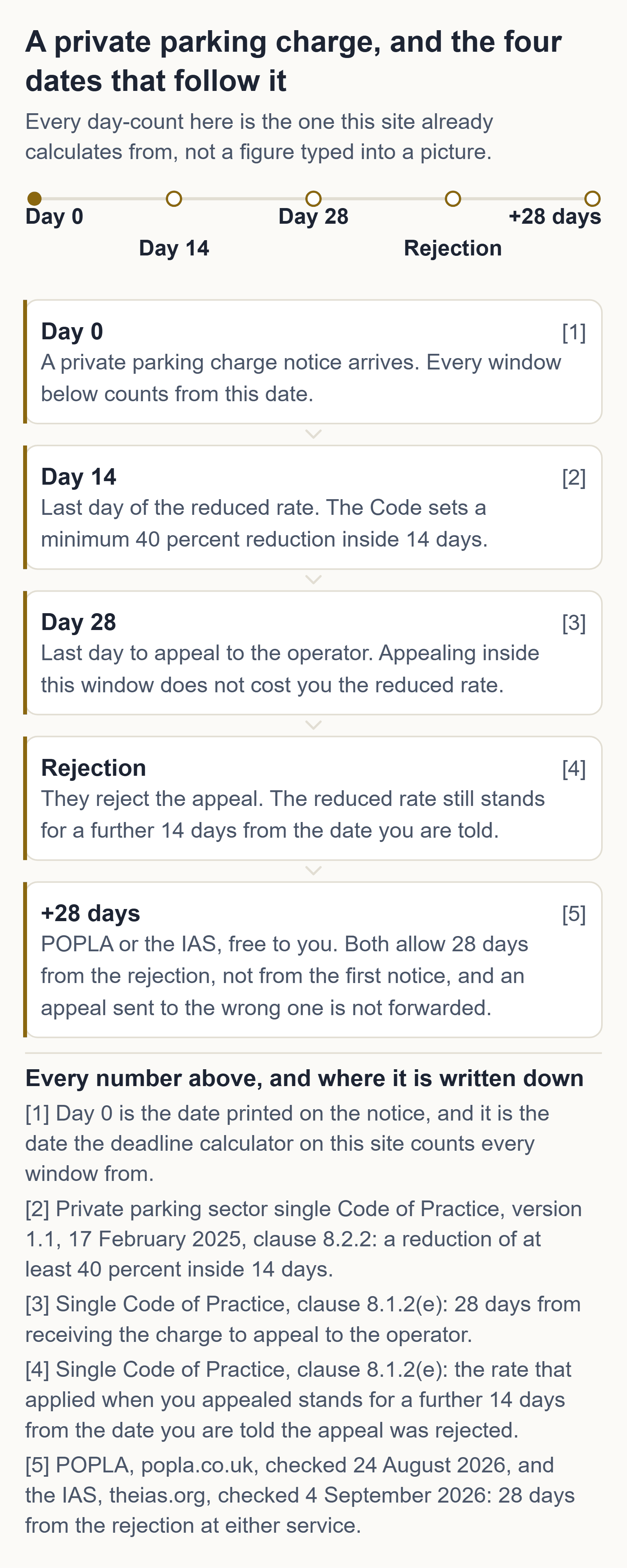
Where you actually are in the chain
| Stage | Who sends it | Real power |
|---|---|---|
| Parking Charge Notice | The operator | None — it is an invoice |
| Reminders | The operator | None |
| Debt collection letters — you are here | A collection firm (DCBL and others) | None. Letters and phone calls only |
| Letter before claim | The operator's solicitors (often DCB Legal and similar firms) | None yet — but it starts a 30-day clock you should answer |
| County court claim | The court, after the operator issues | The first real deadline: 14 days from service of the particulars to respond, 28 if you acknowledge first |
| Judgment, then enforcement | The court | Only here do bailiffs, registers and credit files exist |
“A bailiff ('enforcement agent') may visit your home if you do not pay your debts - such as Council Tax bills, parking fines, court fines and county court, high court or family court judgments.”
— Bailiffs: your rights, GOV.UK — read at source 30/08/2026
Read GOV.UK's list again: every route to an enforcement agent runs through a court order of some kind. A private parking charge at the debt-collection stage appears nowhere on it.
The two names on a parking letter
Two firms dominate this stage of UK private parking, and they are different things:
- DCBL (Direct Collection Bailiffs Ltd) — a debt recovery and High Court enforcement business. The parking letters come from its debt recovery side, which holds no court power over your charge. What a DCBL parking letter actually means →
- DCB Legal — a law firm that issues county court claims for parking operators in volume. A "letter of claim" from a solicitor is the stage you answer in writing, within its 30 days. What a DCB Legal letter of claim means →
What to do, in order
A "notice of debt recovery" is stage 3 in the table: noise. A "letter before claim" or "letter of claim" is stage 4: answer it within 30 days. A claim form with a court seal is stage 5: different page, real deadline.
The collector bought a file, not a case. If the charge was appealable — bad signage, no keeper liability, wrong notice timing — it still is, as a defence. Of 107,202 cases POPLA concluded last year, 45.8% ended with the charge cancelled — operators withdrew 34,502 times before a ruling. Weak charges are the norm in this industry, not the exception.
Phone calls leave no record and collectors know it. Dispute in writing, keep copies, and ask for the documents they rely on: the contract with the landowner, the signage photographs, the notice timeline.
An action founded on simple contract cannot be brought more than six years after the event. A charge from 2021 that has never seen a courtroom is running out of road, not gathering force.
“An action founded on simple contract shall not be brought after the expiration of six years from the date on which the cause of action accrued.”
— Limitation Act 1980, section 5 (actions founded on simple contract), section 5 — checked 29/08/2026
Common questions
Can a debt collection agency do anything about a parking charge?
It can write to you, phone you and add its fee to the demand. It cannot take your property, cannot visit with any power beyond asking, cannot touch your wages or bank account, and cannot record anything on your credit file. Every enforcement power in this story belongs to a court, and no court is involved at the debt-collection stage.
Should I ignore parking debt collection letters?
Ignoring them is not dangerous in itself — the letters carry no power — but it is not the best move either. If the charge is beatable, dispute it in writing and make them state their case. If a letter headed 'letter before claim' or 'letter of claim' arrives, respond within its 30 days: that letter is the formal doorstep of a real court claim, and a reasoned reply is often where the matter dies.
Can debt collectors add fees to a parking charge?
Operators routinely add a debt recovery charge — commonly £70 — when the charge is passed on. Whether such add-ons are recoverable is one of the live battlegrounds in parking litigation, and courts have gone both ways on the facts. What is certain: the fee is part of the claim they would have to prove, not a sum any collector can simply take.
How long can a parking charge be chased?
Six years from the event, in England and Wales — an action founded on simple contract cannot be brought after that. A charge that is years old and has never been to court is not gathering interest in a register anywhere; it is a claim getting older.
Is a debt collection letter the same as a CCJ?
No, and the distance between them is the whole point. A debt collection letter is a private company asking again. A CCJ exists only after a county court claim has been issued, served and either lost or ignored. Nothing touches your credit file until that judgment stage — and a judgment paid within one month of being entered is removed from the register entirely.
Before you decide anything, check what you are actually holding
The collector inherited whatever weaknesses the original charge had. Check the operator, the route and the record in sixty seconds — it is the fastest way to know whether this file is worth their court fee.
Check my parking ticket — freeYour operator's appeals body, your deadlines, the published odds and your next step. No email, nothing stored.
Want the appeal letter written for your case instead? The builder is free, on screen and as a download, with no account and no email address.
Questions people ask
These are the questions Google publishes underneath the search this page is written for, measured on 9 and 10 September 2026. Each one is answered here in a sentence, and where we hold no source for an answer the sentence says so instead of guessing.
Can I ignore a parking ticket from a private company?
You can ignore a parking ticket from a private company in the sense that nothing happens automatically — it is an invoice, not a fine — but ignoring it forfeits both free appeal stages and hands the file to a debt collector while the amount climbs.
How long can you be chased for a private parking ticket?
You can be chased for a private parking ticket for six years: section 5 of the Limitation Act 1980 bars an action founded on simple contract more than six years after the event, so a charge from six years ago is running out of road rather than gathering force.
Do I legally have to pay private parking fines in the UK?
You do not legally have to pay private parking fines in the UK on the strength of the notice alone: a private charge is a civil claim for breach of contract, and only a county court judgment can make you pay one.
What's the worst that can happen if you don't pay a parking ticket?
The worst that can happen if you don't pay a private parking ticket is a county court claim and, if you lose or ignore it, a judgment with costs added — there are no bailiffs, no credit-file entry and no wage deduction before a judgment exists.
What happens if I never received a PCN?
If you never received a PCN, say so in writing and check the dates: the Protection of Freedoms Act 2012 fixes when a notice to keeper may be served — Schedule 4, paragraph 9(5) allows 14 days from the day after the alleged breach where the charge came from a camera — and a notice served outside that window cannot make the keeper liable at all.
Am I legally bound to pay a parking charge notice?
You are not legally bound to pay a parking charge notice simply because it arrived: it is an allegation that you broke a contract, and it becomes a debt only if you agree it or a court decides it.
Will any of this touch my credit file? → · A claim form has arrived → · My appeal was rejected — what now? →
Sources named above: Protection of Freedoms Act 2012, Schedule 4